
From Traditional DMS to Modern Enterprise Content Management: Why Enterprises Must Upgrade in 2026
The problem: “We have a DMS”—but content still controls you
Many enterprises already run a Document Management System (DMS). Yet leadership teams still face familiar pain: approvals stall in email threads, teams keep duplicate files “just in case,” audits trigger fire drills, and sensitive documents leak through uncontrolled sharing. On paper, the organization is “digitized.” In reality, content remains fragmented across shared drives, inboxes, file servers, legacy DMS folders, chat tools, and cloud storage—without consistent governance.
The core issue is that traditional DMS platforms were built for storage and basic retrieval. Modern enterprises, however, need much more than a digital filing cabinet. They need a system that treats content as a managed, secure, compliant, automatable asset across its lifecycle—from creation to collaboration, approval, retention, and defensible disposal.
That is why 2026 is a critical inflection point: organizations that upgrade from traditional DMS to modern Enterprise Content Management (ECM) will reduce operational risk, speed execution, and become AI-ready—while those that delay will carry rising compliance costs and increasing exposure.
Why this matters today (and why 2026 makes it urgent)
For CTOs, Operations Heads, Compliance and Risk leaders, and Finance executives, content management is no longer an “IT hygiene” project. It directly affects speed, control, and resilience. In 2026, pressure intensifies due to:
Upgrading to ECM is not about adding “more features.” It is about governance + automation + security + intelligence—designed for enterprise scale.
Key challenges enterprises face with traditional DMS
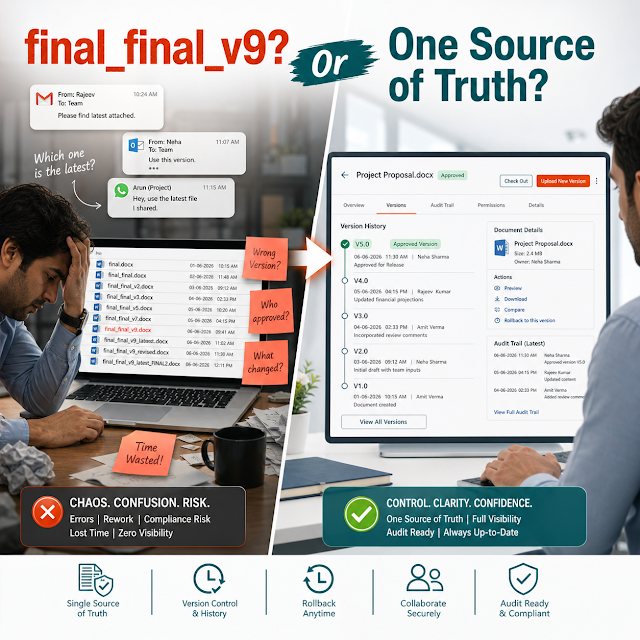
Folder-based storage breaks at scale. Different teams create inconsistent naming conventions, duplicates multiply, and “final_v7_reallyfinal.pdf” becomes normal. Search returns too many or too few results, and time is wasted hunting for the latest approved version.
Critical workflows—contracts, invoices, policies, quality documents—often move through email or chats. Decisions become hard to audit, escalations are manual, and cycle times depend on individual follow-ups.
A DMS may store documents, but governance requires classification, retention rules, legal holds, access policies, and auditable trails—applied consistently across departments.
Content does not exist in isolation. Procurement, ERP, CRM, HRMS, and ticketing tools all generate and consume documents. Without integration, teams download/upload copies and lose traceability.
Many legacy platforms struggle with granular permissions, secure external sharing, encryption controls, and continuous monitoring. One misconfigured share can expose sensitive financial, personal, or IP data.
AI initiatives fail when content is messy: missing metadata, unclear versions, no lifecycle, and inconsistent access rights. ECM provides the structure that makes AI results trustworthy and secure.
The hidden risks of staying on a traditional DMS
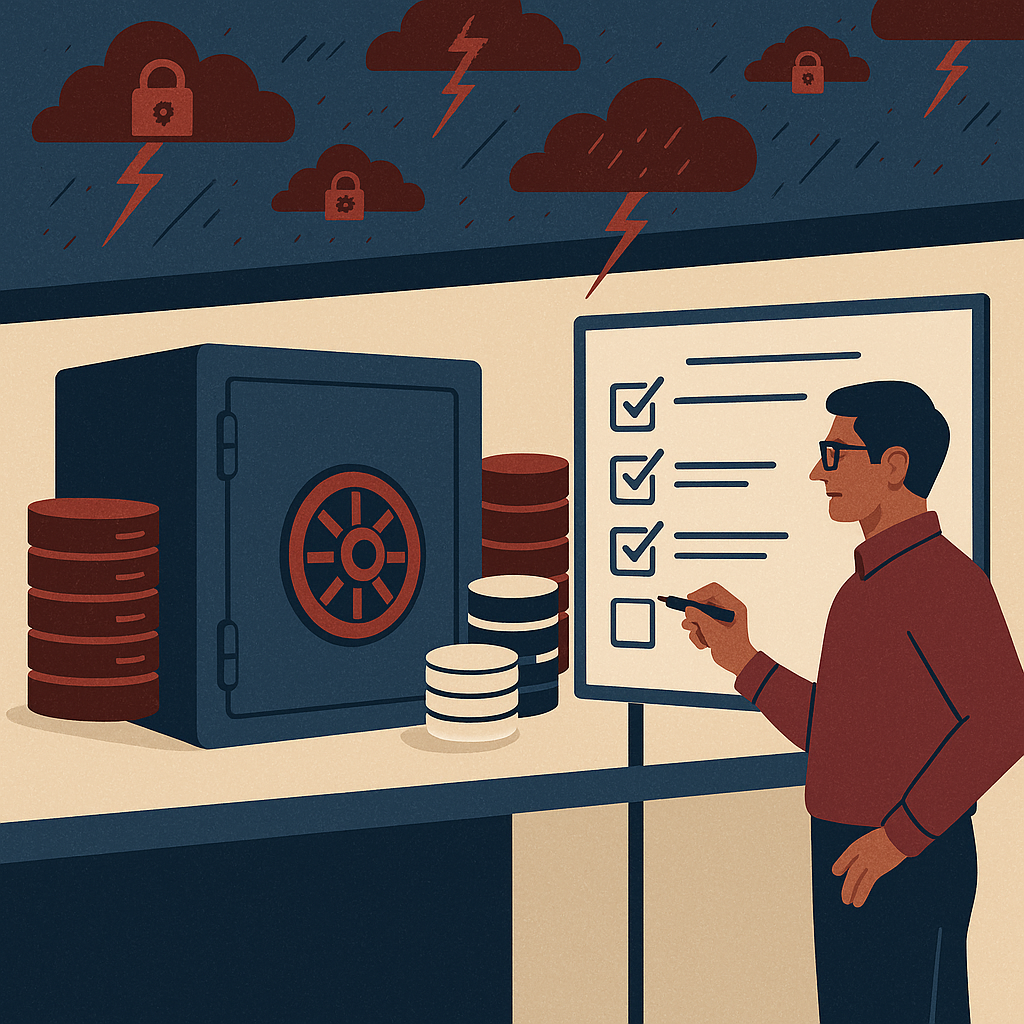
Enterprise leaders often underestimate the cost of “good enough.” But in compliance-heavy environments, the risk curve is steep. A traditional DMS may appear stable—until it becomes a liability.
- Audit exposure: incomplete trails, inconsistent approvals, inability to prove document integrity.
- Data leakage: uncontrolled downloads, uncontrolled shares, and lack of policy-based access.
- Operational drag: employees spend time searching, recreating documents, and chasing approvals.
- Legal and retention failures: over-retention increases discovery costs; under-retention increases penalties.
- AI misuse or inaccurate outputs: when AI is pointed at ungoverned repositories, it can surface outdated, incorrect, or unauthorized content.
For Finance and Compliance leaders, these are not theoretical issues—they translate into penalties, write-offs, delayed revenue recognition, and reputational damage.
Deep-dive: What “modern ECM” means in 2026
Enterprise Content Management (ECM) is a broader discipline than document storage. Modern ECM is an operating layer for enterprise content—enforcing how content is created, classified, accessed, processed, retained, and audited.
ECM defines lifecycle states (draft, review, approved, published, archived) and enforces transitions via rules and workflows. This reduces “shadow versions” and ensures teams use the correct, approved content.
Access control, retention schedules, legal holds, and classification tags are applied systematically. Governance becomes proactive rather than reactive during audits.
ECM connects content to processes—invoice approvals, vendor onboarding, CAPA/quality procedures, HR policy acknowledgments, contract reviews—so work moves with measurable SLAs and escalations.
OCR and structured metadata transform PDFs and scans into searchable, governed assets. Even when documents arrive via email, upload, or scanning, they become part of an enterprise taxonomy.
Modern ECM is built for least-privilege access, comprehensive audit trails, secure sharing, and controls that align with enterprise security standards and compliance expectations.
Well-governed metadata and permissions enable AI search, summarization, and document Q&A without exposing unauthorized content or mixing outdated versions into decision-making.
In a traditional DMS, contracts are stored after signing, while negotiation and approvals happen in email. In ECM, the contract is created/ingested, assigned metadata (vendor, amount, renewal date), routed through legal and finance approvals with SLAs, signed via e-signature integration, stored as a controlled record, and tracked for renewals—reducing missed renewals, maverick spend, and compliance gaps.
A practical upgrade approach: how enterprises should modernize
Upgrading from DMS to ECM is best approached as a business transformation with measurable outcomes, not a file migration exercise. Decision-makers should anchor the program on risk reduction and operational acceleration.
Start with 2–4 workflows that create measurable impact (invoice approvals, contract lifecycle, SOP/policy approvals, customer onboarding). Avoid boiling the ocean.
Establish taxonomy, metadata, retention rules, and access models. Governance is what makes automation and AI safe and reliable.
Implement workflow steps, escalations, and audit trails. Track cycle times, rework, and exception rates to prove ROI.
Connect ECM to ERP/CRM/HRMS and email ingestion so documents become a natural byproduct of business operations, not a manual admin task.
A phased program reduces disruption, accelerates adoption, and lets leadership fund expansion using early gains.
Feature breakdown: what to demand from an ECM platform in 2026
When evaluating platforms, look beyond checklists. Focus on capabilities that reduce risk, accelerate throughput, and prepare your content for AI-powered discovery.
Ensure least-privilege access, team-based permissions, and controlled sharing—especially for external vendors, auditors, and cross-entity collaboration.
Enforce “single source of truth” for SOPs, policies, templates, and customer-facing documents. Prevent use of outdated versions in operations.
Approval chains, delegation, SLA escalations, exception handling, and complete audit logs are critical for compliance and speed.
Search should support structured filters (vendor, customer, date, department) and fast discovery across large repositories—without exposing restricted content.
Automate retention schedules, archival, and defensible deletion. Support legal holds to prevent accidental deletion during investigations.
Transform inbound documents (invoices, KYC files, shipping docs) into classified, searchable items with reduced manual data entry.
Visibility into bottlenecks, overdue approvals, policy acknowledgments, and audit readiness turns content operations into a managed discipline.
Integration reduces manual handling and ensures traceability across ERP/CRM/HRMS. This is the difference between “storage” and “system-of-work.”
If your current DMS cannot deliver these reliably at enterprise scale, the platform is no longer aligned with 2026 realities.
Traditional DMS vs Modern ECM: what changes for leadership
Industry use cases: where ECM delivers immediate leverage
ECM creates value across industries, but the strongest benefits appear where compliance, volume, and cross-functional workflows intersect.
KYC documents, claims processing, policy issuance, underwriting packages, and customer communications require strict access controls, audit trails, and retention. ECM reduces turnaround time while improving audit readiness.
SOPs, change controls, CAPA records, supplier quality docs, and inspection reports benefit from version control and controlled distribution—preventing production errors caused by outdated instructions.
Patient-related documents, lab reports, consent forms, and research documentation require tight privacy controls and long-term retention. ECM supports compliant access and traceable change history.
Drawings, contracts, permits, compliance certificates, and site documentation must be accessible to field and office teams without losing control. ECM enables secure external sharing and consistent document versioning.
Proposal development, client deliverables, and knowledge reuse rely on fast discovery and version integrity. ECM reduces rework and supports structured knowledge management.
Invoice processing, employee document management, policy approvals, and legal case files benefit from workflow automation, controlled access, and consistent retention policies.
Implementation perspective: what leaders should plan for
A successful ECM rollout aligns people, process, and platform. The technology is only one component; governance and adoption decide outcomes.
Define executive sponsorship (CTO/COO/CFO), process owners (AP, Legal, HR, Quality), and governance owners (Compliance, Security). Clear accountability prevents “IT-only” deployments.
Standardize metadata and document types early. Decide what must be captured at ingestion (vendor name, invoice number, contract renewal date) versus optional enrichment later.
Migrate what matters. Many enterprises avoid migrating obsolete or duplicate files; instead, they bring forward active records with proper metadata and retention policies.
Align with identity management, access policies, audit logging, and retention rules. Make permission boundaries explicit before enabling external sharing or AI features.
Train teams on “new ways of working”: structured upload, consistent metadata, and workflow usage. Adoption improves when ECM reduces daily friction and eliminates duplicate work.
Measure cycle time, exception rates, audit response time, retrieval time, and compliance coverage. Finance leaders will want proof of cost-to-serve reduction.
Business impact and ROI: what improves when ECM replaces legacy DMS
ECM upgrades are often justified using “soft benefits” like productivity. In 2026, the strongest business case ties directly to risk reduction, cash flow acceleration, and measurable operational efficiency.
Automated approvals reduce waiting time and follow-ups. For example, invoice and vendor approvals move faster, reducing late fees and improving supplier relationships.
Auditable workflows and retention policies reduce time spent gathering evidence. Compliance teams shift from firefighting to oversight.
Version control and structured templates cut document recreation. Teams stop redoing work because they cannot find the right file or trust it.
Granular access, secure sharing, and audit logs reduce the probability and blast radius of data exposure—protecting revenue and brand trust.
The ROI case becomes strongest when you quantify: hours spent searching, approval cycle-time delays, audit preparation effort, and cost of exceptions (late payments, missed renewals, contract leakage). ECM turns these hidden costs into controllable metrics.
Future readiness: the AI angle (and why governance comes first)
In 2026, AI-powered search and document intelligence are becoming a competitive baseline. Leaders want faster answers from content: “What are our renewal risks this quarter?” “Which SOP is applicable for this plant?” “Show all customer contracts with a price increase clause.”
But AI is only as reliable as the content foundation. If documents are duplicated, misclassified, and inconsistently permissioned, AI can produce inaccurate summaries or expose sensitive information. Modern ECM establishes:
AI search must respect access control. ECM ensures users only discover content they are authorized to view—critical for HR, legal, finance, and customer data.
Metadata drives relevance: document type, business unit, effective date, status, and owner. This reduces hallucinations and prevents outdated policy usage.
For regulated industries, you must show how decisions were made. ECM ties AI-assisted outcomes back to controlled source documents with version history.
The most future-ready organizations use ECM to create a governed “enterprise knowledge layer” that enables AI safely—without compromising compliance or security.
FAQs
No. DMS primarily focuses on storing and retrieving documents. ECM manages content across its lifecycle with governance, workflow automation, compliance controls, integrations, and AI-ready discovery.
Start with a high-volume, measurable workflow like invoice approval (AP), contract approvals (Legal/Procurement), or SOP/policy management (Compliance/Quality). Track cycle time reduction, exception reduction, and audit response time.
Usually, no. Many enterprises migrate active and regulated records first, while archiving or sunsetting outdated content. A smarter strategy is “governance-led migration” where only content that needs lifecycle control is brought forward with proper metadata.
ECM provides consistent access controls, audit trails, approval history, retention rules, and reporting—so evidence is available on-demand instead of being rebuilt manually for each audit.
Yes—when permissions, metadata, and version control are enforced. ECM provides the governed foundation for AI search, summarization, and document Q&A while respecting security boundaries.
Ready to upgrade from traditional DMS to modern ECM in 2026?
If your organization is facing audit pressure, slow approvals, scattered content, or increasing security risk, it’s time to move from “document storage” to “content governance + workflow automation.” A modern ECM strategy can reduce risk, accelerate execution, and create an AI-ready foundation for enterprise search and knowledge reuse.