Speed invoice approvals with AI and workflow automation to reduce errors, improve control, and strengthen finance compliance.
Accounts Payable Automation (APA) in India, invoice processing automation, vendor invoice workflow, purchase order matching, GRN validation, GST compliance document management, e-invoicing, enterprise document management system, secure document repository, audit trail, role-based access control, workflow automation, AP analytics, invoice OCR, approval routing, shared services AP, compliance document management, AI-enabled content operations for finance.
Accounts Payable Automation APA in India Sharedocs Enterprise
Accounts Payable in many Indian enterprises still runs on a fragile mix of email chains, shared folders, paper invoices, and approvals that depend on who is available that day. The result is familiar: invoice backlogs, repeated vendor follow-ups, missed early-payment discounts, avoidable late fees, and finance teams spending more time chasing documents than managing cash.
Accounts Payable Automation (APA) fixes this by combining structured document capture, validation, approvals, and audit-ready storage. But automation only delivers full value when invoice documents, purchase orders, GRNs, and approval evidence are governed end-to-end. That’s where a ShareDocs-style enterprise document management and workflow foundation becomes the difference between “we digitized a step” and “we transformed AP operations.”
What is Accounts Payable Automation (APA)?
Accounts Payable Automation (APA) is the use of digital workflows to capture invoice data, validate it against rules (like PO/GRN matching), route invoices for approvals, and store all supporting documents with an audit trail—so invoices are processed faster, with fewer errors and stronger compliance.
Why it matters
APA reduces cost per invoice, improves vendor satisfaction, protects against duplicate payments, and strengthens audit readiness. In India, it also supports GST documentation discipline and e-invoicing-aligned processes by ensuring every invoice is traceable, searchable, and approval-backed.
How it helps Finance leaders
APA provides predictability: measurable cycle times, clear bottlenecks, controlled exceptions, and a single source of truth for invoice documents—helping CFOs improve working capital decisions while reducing operational risk.
Why this matters today (AI search, compliance, scale, buyer expectations)
The AP function is being pushed by four forces at once:
AI search expectations
Teams expect instant answers: “Show invoices pending with Plant A,” “Find all invoices for vendor X for Q3,” or “Where is the approval proof?” Without structured documents, AI-driven retrieval becomes unreliable.
Compliance pressure
Audits demand traceability: who approved, when, against what policy, with what supporting documents. If evidence sits in inboxes, your control environment weakens.
Scale & shared services
Growing invoice volumes, multi-branch operations, and shared services need standardized workflows and centralized visibility—without slowing local business units.
Buyer expectations
Vendors expect faster confirmations and fewer disputes. Internal stakeholders expect approvals from mobile, clear escalation, and accurate cost allocations.
Key challenges in AP automation (India): what blocks speed and control
Many AP projects stall not because invoice capture is impossible, but because documents and decisions aren’t governed. The following issues typically cause delays, errors, or audit exposure.
Unstructured invoice intake
Invoices arrive via email, WhatsApp, courier, or vendor portals. Without a controlled intake and indexing standard, invoices get lost, duplicated, or processed late.
Weak matching discipline
PO/GRN/service-entry matching often depends on manual checks. Exceptions get handled informally, making outcomes inconsistent and hard to audit.
Approval latency
Approvals depend on individuals, not policy. When approvers travel or change roles, invoices stall and vendors escalate.
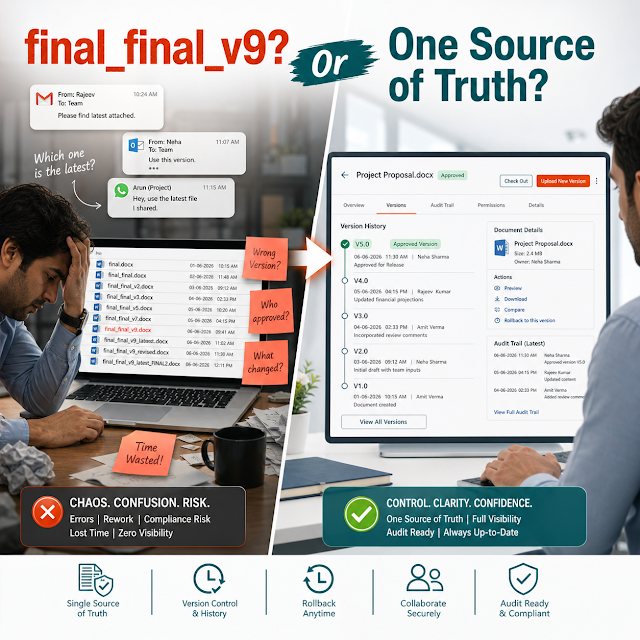
Version confusion
Multiple invoice copies float around (scans, PDFs, printouts). Without version control, AP teams may approve outdated or altered documents.
Insufficient document security
Invoices contain bank and tax details. Poor access control increases the risk of internal leakage, fraud, and privacy breaches.
Audit trail gaps
If you can’t prove who approved what and why, auditors treat it as a control weakness—raising remediation work and risk ratings.
Risks of doing nothing
- Direct financial leakage: duplicate payments, missed discounts, late fees, and inaccurate accruals.
- Vendor relationship damage: delayed responses, disputes, and escalation to procurement leadership.
- Higher fraud risk: invoice manipulation, approval bypass, and unauthorized vendor changes thrive in unmanaged document flows.
- Audit pain: frantic evidence collection across inboxes and shared drives, increasing audit time and stress.
- Scaling costs: invoice volume grows, so headcount grows—without improving control or predictability.
Deep-dive: how these problems break real AP workflows
Consider a common end-to-end flow for a mid-to-large Indian enterprise handling multi-location procurement:
Typical manual AP workflow (where delays and risk accumulate)
1) Invoice receipt
The vendor emails an invoice PDF. Someone downloads it, renames it, and forwards it. If multiple people receive it, duplicates are created. If the file name is inconsistent, it becomes hard to search later.
2) Data entry + validation
AP keys invoice number, date, amounts, GSTIN details, PO reference, and business unit. If data is entered incorrectly, it triggers payment issues or compliance mismatches later.
3) Matching and exception handling
For PO invoices, AP checks PO and GRN documents. For service invoices, AP searches for service-entry approvals. Exceptions become long email threads: “Please confirm rate,” “GRN pending,” “Budget owner to approve.”
4) Approvals
Approvals happen in email or on paper. If the approver changes roles or is on leave, invoices stall with no clear escalation. Audit evidence becomes screenshots and forwarded emails.
5) Payment processing + storage
Payments are scheduled, but supporting documents remain scattered. When a vendor disputes a deduction or an auditor requests proof, the team scrambles to recreate the trail.
The core issue isn’t simply “manual vs automated.” It’s uncontrolled documents and decisions. Without structured capture, indexing, access controls, workflows, and retention policies, AP remains vulnerable even if some steps are digitized.
Solution approach: structured document management + workflow automation
A ShareDocs-style approach treats every invoice as a governed business record connected to its process context: vendor, PO, project, cost center, location, approver, and status. The goal is a single, secure system of record for AP documents—backed by consistent workflows and audit trails.
Operating model: “Capture → Classify → Validate → Approve → Store → Prove”
- Capture: invoices ingested from email, upload, scan, or vendor intake channel.
- Classify: document type + business metadata applied consistently.
- Validate: rule checks, duplicate detection, and matching readiness.
- Approve: policy-driven routing with escalation and delegation.
- Store: controlled repository, retention rules, and secure access.
- Prove: complete audit trail for every touchpoint and decision.
Feature breakdown (card view)
Centralized invoice repository
Store invoices, POs, GRNs, contracts, and approval evidence in one controlled location with fast search and consistent indexing.
Metadata-driven organization
Tag documents by vendor, GSTIN, plant/branch, cost center, invoice date, PO number, and status to enable reliable retrieval and reporting.
Workflow automation for approvals
Route invoices based on amount thresholds, department, project, or vendor type. Add SLAs, escalation, and delegated approvals to reduce latency.
Role-based access control
Limit access by function, location, or vendor category. Protect sensitive banking and tax data with controlled sharing and permissions.
Audit trail & version control
Track who uploaded, viewed, edited, and approved. Maintain consistent versions to prevent “wrong attachment” or post-approval changes.
Compliance-ready retention
Apply retention policies by document type and business rules so finance teams can retrieve evidence quickly without storing unnecessary duplicates.
Comparison: manual AP vs structured APA (no tables)
Manual / email-driven AP
- Invoices scattered across inboxes and folders
- Inconsistent naming and missing metadata
- Approvals depend on individuals, not policy
- High effort to answer audit or vendor queries
- Limited visibility into bottlenecks and SLA breaches
Structured APA with ShareDocs-style DMS + workflows
- Single source of truth for invoices + supporting docs
- Standard indexing for consistent, fast search
- Policy-based routing with escalation and delegation
- Built-in audit trail and controlled access
- Measurable cycle time, exception queues, and dashboards
Industry use cases in India (realistic scenarios)
Manufacturing: multi-plant invoice approvals
A manufacturer receives invoices for raw materials across multiple plants. AP needs quick PO/GRN confirmation and plant-level cost allocation. Structured document management links each invoice to PO/GRN records and routes approvals to the correct plant controllers with SLA escalation.
Retail & distribution: high volume, low value invoices
Hundreds of courier, utilities, and maintenance invoices come in monthly. Automation standardizes intake, flags duplicates, and enables “touchless” approvals under defined thresholds—reducing cost per invoice without weakening controls.
IT/ITES: service invoices and milestone billing
Service invoices require milestone acceptance, contract checks, and stakeholder sign-off. A structured workflow attaches SOWs, acceptance notes, and approvals to the invoice, ensuring that every payment is defensible during audits.
Construction & EPC: complex supporting documents
Vendor invoices may need site measurements, work completion certificates, and retention calculations. A DMS-backed APA process ensures the right attachments are mandatory before approvals can proceed, reducing disputes and rework.
Implementation perspective: how to deploy APA without disruption
Enterprise AP automation succeeds when implemented in phases with clear governance. A practical rollout approach:
Phase 1: Standardize intake
Define invoice naming, metadata, and a single intake channel. Establish the invoice “system of record.”
Phase 2: Build approval workflows
Model approval policies by threshold, department, and exception types. Add SLA escalation and delegation.
Phase 3: Exception control
Create exception queues: missing PO, GRN pending, price variance, missing attachments—so exceptions are tracked, not lost.
Phase 4: Optimize & measure
Measure cycle times, touchless rate, and bottlenecks. Continuously improve rules and routing.
Key governance tip: decide upfront which documents are mandatory for each invoice type (PO, non-PO, services) and enforce it in the workflow. This prevents “approval without evidence,” a common audit finding.
Business impact & ROI: where automation pays back
- Lower processing cost: fewer manual touches per invoice and reduced rework from missing documents.
- Shorter cycle time: faster approvals, clearer exception ownership, and predictable payment schedules.
- Reduced leakage: duplicate detection, matching discipline, and controlled approvals reduce wrong/duplicate payments.
- Better cash management: improved visibility into liabilities and accrual accuracy supports stronger working capital decisions.
- Audit efficiency: instant retrieval of invoice + PO + GRN + approval trail reduces audit response time substantially.
Finance teams typically see ROI from a combination of hard savings (time, headcount avoidance, reduced penalties) and risk savings (fewer disputes, fewer audit observations). The more invoice volume and branch complexity you have, the faster structured APA pays back.
Future-readiness: APA built for AI-enabled content operations
AI can only improve AP if your content is trustworthy. When invoices are stored with consistent metadata, controlled versions, and complete audit trails, you unlock AI-friendly operations:
Reliable AI search & retrieval
Ask precise questions and get precise answers because documents are indexed consistently (vendor, amount, invoice date, location, approver, status).
Exception prediction
Structured exception categories help identify patterns—vendors with frequent price variances, plants with GRN delays, or approvals that routinely breach SLAs.
Policy enforcement at scale
As the organization grows, policy-driven workflows maintain consistency without depending on “tribal knowledge” in the AP team.
What is AI-enabled content operations for Finance?
It is the practice of managing invoices and supporting documents as structured, secure content so AI and analytics can reliably search, summarize, detect anomalies, and guide faster decisions—without compromising compliance or auditability.
FAQ (search-style questions)
1) What is the best way to reduce invoice approval delays in AP?
Use policy-based workflows with SLAs, escalation, and delegation. Pair it with a centralized repository so approvers always see the correct invoice and required supporting documents.
2) How do I prevent duplicate payments during invoice processing?
Enforce duplicate checks using invoice number, vendor, amount, and date, and ensure the system stores a single approved version with a traceable audit trail across all actions.
3) Why is document management critical for Accounts Payable Automation?
Because AP is evidence-driven. If invoices, POs, GRNs, and approvals aren’t governed with access controls, versioning, and retention, automation becomes incomplete and audit response becomes slow and risky.
4) Can AP automation work across multiple branches and business units in India?
Yes—when metadata includes branch/plant and cost center, and workflows route approvals by business rules. Central visibility with local routing is the standard pattern for shared services and multi-location enterprises.
5) What should I look for in an enterprise AP automation approach?
Look for centralized storage, strong search, workflow automation, role-based access, audit trails, exception queues, and compliance-ready retention—so AP is faster without losing control.
Explore more from ShareDocs
Ready to modernize Accounts Payable Automation (APA) in India with structured document control?
If your AP team is battling invoice backlogs, missing supporting documents, delayed approvals, and audit stress, a ShareDocs-style DMS + workflow approach can help you standardize intake, speed approvals, and maintain audit-ready evidence at scale.
Tip: Share your current monthly invoice volume, number of branches, and top 3 exception types (missing PO, GRN pending, price variance). That’s enough to map a high-impact rollout plan.