See how banks and financial teams improve compliance, document control, and operational efficiency with ShareDocs.
ShareDocs financial services automation company in India for enterprise document management, compliance document management, secure document workflows, audit trail, version control, policy and procedure management, KYC document management, loan origination document automation, insurance claims document workflow, NBFC document tracking, banking content operations, AI-enabled content operations, records management, retention, approvals, e-sign integration readiness, secure customer data handling.
Best Financial Services Automation Company in India Sharedocs
Financial services teams don’t fail because they lack effort—they fail because critical work is buried inside scattered emails, shared drives, WhatsApp attachments, and vendor portals that don’t talk to each other. The result is familiar: slow loan approvals, missing KYC pages, repeated customer follow-ups, inconsistent policy documentation, weak audit readiness, and high operational risk.
If you operate in banking, NBFCs, insurance, wealth management, fintech, or back-office processing, your “real product” is often documents + decisions. Automating financial services requires more than digitizing paperwork. It demands structured document management, controlled workflows, security, and compliance-by-design—so every file is traceable, every approval is accountable, and every customer interaction is faster and safer.
What is financial services automation?
Financial services automation is the use of structured workflows, document control, and secure systems to reduce manual effort across customer onboarding, underwriting, approvals, servicing, claims, collections, compliance reporting, and audits—while maintaining governance, traceability, and regulatory alignment.
Why this matters today (AI search, compliance, scale, buyer expectations)
Today’s buyers—retail customers and enterprise clients—expect faster turnaround times, fewer document re-requests, and consistent communication. Meanwhile, regulators and auditors expect evidence: who approved what, when it changed, why an exception was allowed, and whether customer data was protected end-to-end.
The next shift is AI-driven search and decision support. Teams increasingly ask systems natural-language questions like: “Show me the latest KYC checklist used for SME loans,” or “Which cases breached SLA last month due to missing documents?” If your content is unstructured, duplicated, and not tagged, AI can’t reliably retrieve the right answer—and your risk multiplies.
Automation also becomes essential as you scale: more branches, more channels, more products, more partners, more compliance obligations. Without a controlled system, process variation grows silently—until a customer complaint, audit observation, or data incident forces expensive remediation.
Why it matters
Automation protects margins by reducing rework, protects revenue by speeding approvals, and protects the organization by making compliance auditable and repeatable across locations and teams.
Key challenges in financial services automation
Most automation programs stall because they focus only on “scanning documents” or “creating a portal” without controlling the lifecycle: capture, validate, route, approve, retain, and prove. Below are the most common blockers across Indian financial services organizations.
Unstructured document intake
KYC, income proofs, bank statements, policy forms, and declarations arrive in mixed formats and inconsistent naming, making validation and retrieval slow.
Manual handoffs and hidden approvals
Decisions happen in email threads and chats. Approvals lack standard steps, escalation rules, and audit-proof trails.
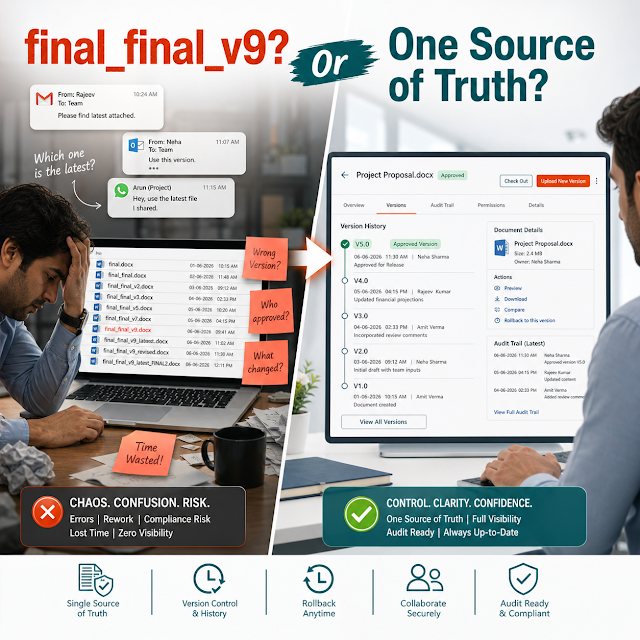
Version confusion
Teams use outdated policy PDFs, old checklists, and stale templates—creating compliance and customer experience issues.
Data security and access sprawl
Customer documents are forwarded, downloaded, and stored locally. Access is difficult to review, revoke, and prove.
Weak audit readiness
Evidence collection becomes a scramble: missing timestamps, missing rationale, and incomplete document histories.
SLA leakage
Cases stall when a single document is pending. Without workflow visibility, you discover delays after customers escalate.
Risks of doing nothing
- Compliance exposure: inconsistent documentation, missing approvals, and unverifiable record trails can lead to audit observations and penalties.
- Data leakage: uncontrolled sharing of KYC and financial data increases breach risk and reputational damage.
- Revenue leakage: slower cycle times reduce conversion (loan disbursals, policy issuance, renewals) and increase drop-offs.
- Operational cost: staff time is consumed by searching, chasing, re-requesting, and reconciling documents across systems.
- Inability to scale: launching new products or expanding branches multiplies process variability, making quality control harder each quarter.
Deep-dive: how these problems break real workflows
Financial services workflows are document-led. When documents are not structured and controlled, downstream steps degrade—even if your core banking/LOS/CRM is strong. Here’s how it typically plays out.
1) Customer onboarding / KYC
Documents arrive via multiple channels. A relationship manager names files differently from a back-office executive. The reviewer can’t quickly confirm completeness (PAN, Aadhaar, address proof, photo, signature, CKYC references, declarations). Missing pages lead to repeated follow-ups and longer onboarding time. Without standardized checklists and a controlled repository, the organization cannot prove what it relied upon at the time of onboarding.
2) Credit appraisal and underwriting
Credit teams juggle bank statements, financials, bureau reports, property documents, and internal notes. When these artifacts are scattered, exceptions are poorly documented, risk memos are version-confused, and approval chains are unclear. Approvers waste time requesting “latest files,” and underwriters can’t easily compare current submissions with prior cycles.
3) Disbursal and servicing
Even after approval, disbursal depends on precise documentation (agreements, mandates, NACH, collateral perfection, insurance, post-dated instruments where applicable). When files are missing or untracked, operations teams stall and customers lose confidence. Servicing later suffers too—because teams can’t retrieve the original signed artifacts quickly when disputes arise.
4) Claims (insurance) / disputes / collections
Claims and disputes require a complete chronology: intake, evidence, verification notes, approvals, and communications. When that chain is broken, settlement decisions slow down and become harder to defend. Collections teams face similar issues: they need documented consent, notices, and interaction records to act confidently and compliantly.
How it helps
A structured document management and workflow system centralizes customer and process documents, applies consistent metadata, enforces approvals, and produces audit-ready evidence—so each workflow step is faster, safer, and easier to measure.
Solution approach: ShareDocs-style structured document management for financial services
The practical way to automate financial services is to treat documents as governed assets—linked to a case, customer, product, branch, and stage—rather than “files in a folder.” ShareDocs-style enterprise document management focuses on structure, control, and traceability so operations can run consistently at scale.
A strong approach typically includes: standardized capture (including scanning/upload), metadata and indexing, role-based access, workflow routing with SLAs, version control, document retention, and audit trails—supported by reporting that shows where work is stuck and why.
If you’re evaluating options, prioritize systems that support both frontline speed (quick upload, quick retrieval, quick sharing) and governance depth (policy controls, approval evidence, retention, and security). Financial services needs both.
Feature breakdown (buyer-focused)
Centralized, searchable repository
Store customer, case, and operational documents in one governed location. Use consistent indexing (customer ID, loan ID, policy number, branch, stage) so teams can retrieve the right file in seconds.
Role-based access and secure sharing
Restrict access by function and geography, reduce uncontrolled downloads, and ensure customer data is handled with least-privilege access. Support controlled sharing for internal and partner collaboration.
Workflow automation with SLAs
Route documents for verification, underwriting, approvals, and exceptions. Track status, enforce steps, and escalate when SLA thresholds are at risk—without relying on follow-up emails.
Version control and document integrity
Maintain a single source of truth for policies, checklists, templates, and customer artifacts. Prevent “final_v7.pdf” chaos and ensure teams always use the latest approved content.
Audit trails and compliance evidence
Capture who uploaded, viewed, edited, approved, and shared documents—plus timestamps and notes. Make audits faster by producing defensible records without manual reconstruction.
Retention and records management
Apply retention rules to align with internal policies and regulatory expectations. Reduce risk by keeping what you must and disposing of what you shouldn’t keep.
Comparison: generic tools vs structured enterprise DMS (no tables)
Many teams try to solve financial workflow problems with shared drives, generic storage, or email-based approvals. That can work at small scale, but breaks under audit pressure and growth. Use this comparison to clarify what “enterprise-grade” should mean for your organization.
Generic storage + email approvals
Search: depends on file naming and memory.
Approvals: scattered across email chains; hard to prove.
Security: downloads and forwards create uncontrolled copies.
Compliance: evidence collection is manual and slow.
Scale: process variations multiply across branches and teams.
Structured DMS + workflow automation (ShareDocs-style)
Search: metadata-driven retrieval by customer/case/product/stage.
Approvals: standardized flows with timestamps and accountability.
Security: role-based access and controlled sharing reduce exposure.
Compliance: audit trails, version history, and retention support governance.
Scale: repeatable workflows with SLA tracking and reporting.
Industry use cases (realistic scenarios)
NBFC loan processing
A mid-sized NBFC standardizes document checklists across branches. Each loan application becomes a case folder with mandatory docs, verification steps, and approval routing. Missing documents trigger automated follow-ups, cutting TAT and reducing rework.
Retail banking operations
The operations team centralizes account opening documents and service requests. Role-based access ensures branches can upload and view only their portfolio, while central compliance can review activity through audit logs and reports.
Insurance claims automation
Claims teams build a structured workflow: intake, document verification, surveyor reports, approvals, and settlement letters. Every document is tied to the claim ID with timestamps, improving transparency and reducing dispute cycle times.
Wealth & investment documentation
Advisors manage client onboarding, risk profiling, mandates, and periodic review documents. Controlled templates and versioning reduce errors and help prove suitability and consent across client interactions.
Policy & SOP governance
Compliance teams maintain policies, SOPs, and circulars with version control, reviews, and acknowledgements. Employees always access the latest approved SOP—reducing process drift and audit findings.
Partner onboarding and vendor files
Procurement and partner teams track contracts, KYC of vendors, NDAs, and due diligence documents. Automated reminders prevent expired documents and support consistent vendor governance.
Implementation perspective (what buyers should plan for)
Successful automation is as much about design decisions as it is about software. A practical implementation focuses on a few high-volume workflows first, then scales. Below is a buyer-oriented view of what “good” looks like.
Step 1: Standardize documents and metadata
Define your core document types (KYC, income proof, statements, agreements, approvals, notes) and the metadata that matters (customer ID, product, branch, date, stage, risk tier). This is what unlocks consistent search, reporting, and AI readiness later.
Step 2: Map workflows with ownership and SLAs
Identify where cases stall: verification, underwriting, exceptions, approvals, disbursal readiness. Assign owners, define SLA checkpoints, and build escalation rules so delays surface early instead of becoming complaints.
Step 3: Access control, audit, and retention by design
Implement least-privilege access, clear role definitions, and auditable actions. Define retention rules aligned to internal policies and regulatory expectations to reduce long-term risk and storage bloat.
Step 4: Scale with reporting and continuous improvement
Use dashboards and reports to find bottlenecks by branch, product, or team. Refine checklists, automate reminders, and tighten exception governance as volumes grow.
Business impact and ROI (what to measure)
ROI in financial services automation is measurable. You can quantify cycle-time reduction, fewer document defects, and audit effort saved—while also reducing security and compliance risk that is otherwise difficult to price until something goes wrong.
Faster turnaround time (TAT)
Reduce time spent searching, validating, and chasing documents. Track TAT by stage to prove improvement and identify persistent friction points.
Lower rework and defect rates
Standard checklists and controlled templates reduce missing documents and incorrect forms, decreasing back-and-forth with customers.
Audit efficiency
Cut audit preparation time by producing document histories, approvals, and access logs quickly—without manual evidence reconstruction.
Reduced security exposure
Centralized control, permissioning, and tracking reduce uncontrolled copies and improve governance across branches and partners.
Future-readiness: AI angle for enterprise content operations
AI doesn’t fix messy content. AI amplifies your content quality—good or bad. If your organization wants AI-assisted operations (faster retrieval, automated classification, smarter exception handling), the foundation is a structured, governed repository with consistent metadata and reliable versioning.
AI-enabled content operations in financial services typically require:
- Findability: consistent naming and indexing so search returns the correct “latest approved” document.
- Context: documents linked to customer/case/stage so AI can answer operational questions precisely.
- Governance: access controls and retention so AI doesn’t expose or learn from restricted content incorrectly.
- Traceability: audit trails so AI-assisted decisions can be reviewed and defended.
In practical terms, a ShareDocs-style DMS helps you become AI-ready by making your content reliable: correct versions, clear ownership, and searchable structure—so future AI features can be applied responsibly.
FAQ
1) What is an enterprise document management system (DMS) for financial services?
It is a governed platform to store, secure, search, version, and route financial documents (KYC, agreements, policies, claims files) with audit trails, access controls, and workflow automation.
2) How does workflow automation reduce loan processing time?
It reduces time lost to manual handoffs by routing tasks automatically, enforcing checklists, flagging missing documents early, and escalating approvals when SLA thresholds are at risk.
3) What should I look for in a document security solution for BFSI?
Look for role-based access, controlled sharing, detailed audit logs, version control, and retention policies—so sensitive customer documents remain protected and access is provable.
4) How does compliance document management help during audits?
It produces reliable evidence: document histories, approval records, timestamps, and access details—reducing audit preparation time and minimizing the risk of missing documentation.
5) Can a structured DMS support AI search and smarter operations?
Yes. AI works best when documents are consistently tagged, version-controlled, and linked to business context (customer/case/stage). Structured content improves answer accuracy and reduces risk from incorrect retrieval.
Ready to automate financial document workflows with stronger control?
If your teams are spending hours searching for documents, reconciling versions, and preparing audit evidence, it’s time to move from scattered files to structured enterprise document management. ShareDocs helps financial services organizations improve turnaround time, strengthen compliance, and scale securely across branches and products.