White Label Document Management System in India with Share Docs DMS explained for modern businesses with practical use cases, risks, and ways to im...
White label document management system in India for enterprises and mid-market teams. ShareDocs DMS supports enterprise document management, document security, role-based access, audit trail, version control, workflow automation, compliance document management, records management, secure file sharing, and AI-ready search and content operations. Deploy a branded DMS portal for partners, clients, departments, or multi-tenant use.
White Label Document Management System in India with Share Docs DMS
If your business handles contracts, invoices, HR files, quality documents, customer onboarding paperwork, project drawings, or compliance records, you already know the hidden cost: documents spread across email threads, WhatsApp, shared drives, pen drives, and personal laptops. This creates slow approvals, duplicate versions, missed renewals, and audit anxiety.
A white label Document Management System (DMS) solves that problem while allowing you to deliver the experience under your own brand. Whether you are an IT services firm, a compliance consultancy, a managed service provider (MSP), a system integrator, or an enterprise group with multiple subsidiaries, white labeling lets you standardize governance and workflows while presenting a unified branded portal to teams and customers.
Definition: What is a white label Document Management System (DMS)?
A white label DMS is a document management platform you can rebrand with your logo, domain, colors, and user experience—so clients and internal teams interact with it as your product. It combines secure document storage, access control, versioning, audit trails, workflows, and search in a centralized system.
Why this matters today (AI search, compliance, scale, buyer expectations)
Document management is no longer just “storage.” Buyers now expect a DMS to behave like a controlled system of record: find the right file instantly, prove who approved what, protect sensitive data, and scale across departments without chaos.
AI search expectations
Teams want search to answer questions quickly: “latest vendor contract,” “approved SOP for process X,” “invoice for PO 123.” A structured DMS makes your content easier to index, retrieve, and reuse.
Compliance and audits
ISO, SOP governance, retention rules, and audit trails matter more. A DMS provides controlled access, version history, and a defensible record of actions.
Scale and collaboration
As teams expand, shared drives collapse under duplicate folders, ad-hoc naming, and unclear ownership. DMS workflows reduce rework and approval delays.
Buyer trust
Customers and partners expect secure portals and reliable document controls. White labeling helps you deliver a consistent brand experience with enterprise-grade security.
Answer block: Why a white label DMS matters
A white label DMS matters because it lets you deliver secure, compliant document operations at scale while protecting your brand equity. You can standardize workflows, access policies, and audit readiness—without pushing users to third-party tools that dilute the client experience.
Key challenges businesses face without structured document management
1) Version confusion and rework
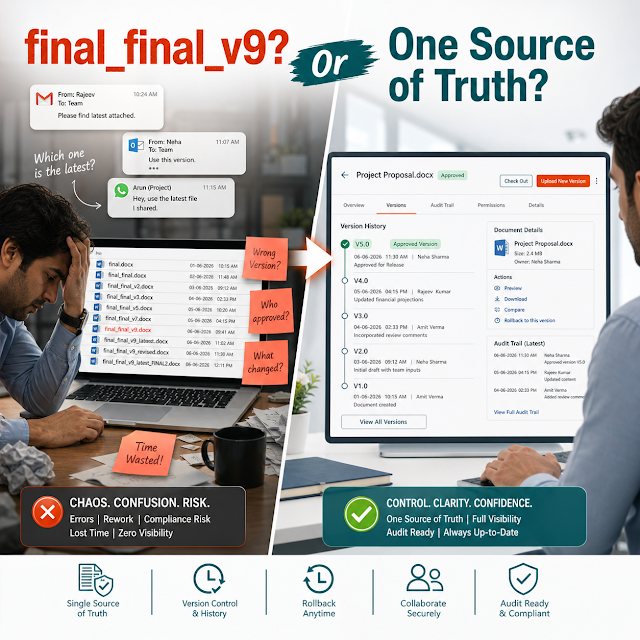
Multiple copies of the same file appear in email, drive folders, and chat apps. Teams waste time reconciling “final_v7” files and fixing errors from outdated versions.
2) Access control gaps
Sensitive documents are often accessible to the wrong people. When employees leave, access removal is inconsistent, and documents continue to exist on local devices.
3) Approval delays
Approvals happen in emails with no central visibility. Stakeholders miss requests, and teams can’t prove who approved what and when.
4) Weak audit trails
In audits, “show me the latest approved SOP and its review history” becomes a firefight. Without structured logs, compliance becomes dependent on memory and manual exports.
5) Poor search and discoverability
If users can’t find documents quickly, they recreate them. This bloats repositories and introduces inconsistent templates, clauses, and processes.
6) Inconsistent retention and governance
Without clear retention rules, you either delete too early (risk) or keep too long (risk + cost). A DMS helps operationalize retention, categorization, and ownership.
Risks of doing nothing
- Compliance exposure: inability to prove document control, approvals, and review cycles.
- Commercial leakage: missed contract renewals, wrong pricing attachments, lost change requests.
- Security incidents: accidental sharing, ex-employee access, and sensitive data copied outside governance.
- Operational drag: time wasted searching, recreating, and reconciling versions.
- Reputation risk: client confidence drops when you cannot provide controlled, traceable documentation.
Deep-dive: how these problems show up in real workflows
Document issues rarely look dramatic on day one. They compound quietly across departments. Here’s how the damage typically spreads across core workflows in Indian businesses:
Sales & contracts
The sales team uses an old MSA template. Legal shares a revised clause set in email. Finance asks for final signed PDFs. No single system shows the latest approved templates, negotiation history, or signed versions. Result: slower closures and higher legal risk.
Procurement & vendor management
Vendor onboarding requires PAN/GST docs, bank proofs, compliance forms, NDAs, and rate cards. Without controlled folders and checklists, teams chase vendors repeatedly, accept incomplete files, and lose visibility on approvals.
HR & employee lifecycle
Offer letters, KYC, policy acknowledgments, and performance documents must be restricted. When stored in shared drives, access gets messy. During audits or disputes, retrieving complete, dated records becomes difficult.
Quality, SOPs & ISO documentation
SOPs must follow controlled review cycles with versioning and acknowledgments. If teams keep PDFs in folders, people continue using outdated instructions—creating nonconformance issues and rework.
Definition: What is enterprise document management?
Enterprise document management is the practice of controlling how documents are created, classified, stored, accessed, approved, retained, and audited across the organization—so teams can collaborate efficiently while meeting security and compliance requirements.
Solution approach: structured document management with ShareDocs-style controls
A practical document management strategy is not “move everything to a folder.” It’s building a system where each document has context: owner, category, version, status, permissions, retention, and workflow. A white label DMS helps you deliver that structure while keeping the user experience aligned to your brand.
In a ShareDocs-style DMS approach, you typically standardize:
- Information architecture: departments, projects, customers, document types, and metadata.
- Access model: role-based permissions, restricted libraries, and least-privilege sharing.
- Lifecycle: draft → review → approved → published → archived/retained.
- Workflow automation: approvals, reminders, escalations, and routing.
- Governance: audit logs, version history, and compliance-ready reporting.
Answer block: How structured document management helps
Structured document management helps by ensuring each file is findable (search + metadata), controlled (versioning + permissions), and provable (audit trail + approvals). This reduces operational friction and supports compliance and customer trust.
Feature breakdown (white label + enterprise-grade document control)
White labeling & branded experience
Offer a DMS portal that looks and feels like your product. A consistent brand experience builds trust with customers and reduces adoption friction internally.
Buyer value: faster rollout to clients and subsidiaries without brand dilution.
Role-based access control (RBAC)
Define who can view, upload, edit, approve, export, or delete—by role, department, project, or customer context. Apply least-privilege access to sensitive libraries.
Buyer value: reduces insider risk and accidental exposure.
Version control & document history
Track revisions cleanly and prevent “final_final” chaos. Keep an authoritative, approved version while retaining history for audits and investigations.
Buyer value: fewer mistakes, faster approvals, stronger traceability.
Workflow automation
Build approval flows for contracts, SOPs, invoices, purchase requests, onboarding documents, and more. Trigger notifications, reminders, and escalations to reduce cycle time.
Buyer value: predictable turnaround times and fewer follow-ups.
Audit trails & compliance reporting
Maintain logs of uploads, views, edits, approvals, and downloads. This helps demonstrate control during ISO audits, internal reviews, and client due diligence.
Buyer value: audit readiness without manual evidence gathering.
Metadata, classification & fast retrieval
Organize documents by type, customer, project, date, status, and owner. Search becomes reliable because content is structured—not dependent on folder memory.
Buyer value: less time searching, more time executing.
Comparison: white label DMS vs shared drives vs generic file-sharing tools
Shared drives
Best for: simple storage.
Limitations: weak workflows, inconsistent permissions, poor auditability, and unreliable version governance.
Typical outcome: folder sprawl + document duplication.
Generic file-sharing tools
Best for: quick external sharing and collaboration.
Limitations: not designed for compliance document management, controlled approvals, or governance across departments.
Typical outcome: “good enough” sharing, but weak system-of-record behavior.
White label DMS (ShareDocs-style)
Best for: enterprise document management, workflow automation, and compliance-ready governance.
Strengths: RBAC, audit trails, structured metadata, approvals, version control, retention, and branded portals.
Typical outcome: faster cycles + stronger security + audit confidence.
Industry use cases (realistic scenarios in India)
A white label DMS is valuable when you need repeatable document processes across customers, branches, or departments—especially when governance and branding matter.
IT services, MSPs & system integrators
Provide a branded document portal for client onboarding, change requests, SOPs, SLAs, security policies, and project deliverables. Standardize approvals and reduce email dependencies.
Manufacturing & quality teams
Manage SOPs, work instructions, inspection reports, CAPA documents, calibration certificates, and supplier compliance files. Maintain controlled review cycles and release only approved documents to production.
Healthcare, clinics & diagnostics
Securely manage sensitive files: lab reports, consent forms, vendor contracts, policies, and HR documentation. Apply strict access controls and maintain logs for governance.
Real estate & construction
Centralize drawings, approvals, agreements, invoices, and compliance documents per project/site. Reduce rework by ensuring teams always use the latest approved drawings and documents.
Finance & shared services
Streamline invoice processing, vendor KYC, PO attachments, and audit evidence. Create consistent indexing and approvals to reduce month-end pressure and missing documents.
Education & training providers
Manage policies, accreditation documents, faculty records, student administration files, and operational SOPs. Enable controlled sharing for stakeholders with traceable access.
Implementation perspective: what successful rollouts do differently
A DMS rollout succeeds when it is treated like an operational system, not just an IT tool. The best implementations focus on priority workflows and governance first, then expand.
A practical rollout sequence
- Pick 2–3 high-impact processes: e.g., contract approvals, vendor onboarding, SOP control, invoice documentation.
- Define a clean taxonomy: document types, metadata, owners, and naming conventions.
- Set permission rules: roles, groups, and restricted libraries for sensitive information.
- Configure workflows: approvals, reminders, escalations, and status transitions.
- Migrate selectively: start with active documents; archive legacy data with a retention plan.
- Train with scenarios: “how to find latest approved SOP,” “how to submit contract for approval,” “how to share securely.”
- Measure adoption: cycle times, search success, reduction in rework, and audit evidence readiness.
If you are building a partner offering or a client-facing portal, white labeling adds one more success factor: ensure the branded UI is consistent across login, notifications, and document portals—so users experience it as a single trusted system.
Business impact & ROI: where the gains come from
ROI from enterprise document management usually comes from time savings, risk reduction, and faster throughput. The measurable improvement is often most visible in approvals, audits, and retrieval.
Faster turnaround time
Automated routing and reminders reduce idle time in approvals. Teams spend less time following up and more time completing work.
Reduced rework and errors
Version control and “single source of truth” publishing reduce mistakes caused by outdated documents, especially in SOPs and contract templates.
Audit readiness
Audit trails and structured records reduce time spent gathering evidence. Reviews become systematic rather than a last-minute scramble.
Lower security exposure
RBAC and controlled sharing reduce accidental exposure. Offboarding becomes cleaner when access is managed centrally.
Future-readiness: AI angle and AI search optimization
AI is changing how employees and customers expect to interact with content. Instead of browsing folders, users ask natural questions and expect direct answers. For that to work reliably, your documents must be governed, consistently labeled, and up-to-date.
Definition: What is AI-enabled content operations in a DMS context?
AI-enabled content operations means structuring, governing, and retrieving documents in ways that make them easier for search systems and AI assistants to locate, summarize, and reference—while still respecting permissions, compliance, and version control.
Cleaner knowledge base
When only approved versions are “published,” AI and enterprise search are less likely to surface outdated guidance.
Better relevance signals
Metadata like document type, customer, process, and status improves retrieval quality for both traditional search and AI-assisted discovery.
Permission-aware answers
A governed DMS supports secure access boundaries—so users only discover documents they’re allowed to see.
If you want AI to improve productivity safely, start by improving the quality of your underlying document system. White label document management gives you that foundation while letting you deliver the experience as your own enterprise solution.
FAQ
1) What is a white label document management system in India?
It is a DMS you can rebrand for Indian customers or internal teams, providing secure document storage, workflow automation, and compliance-ready controls under your company’s identity.
2) How does a white label DMS help with compliance document management?
It supports controlled access, version history, approval workflows, and audit trails—making it easier to demonstrate document control during ISO audits, internal reviews, and customer due diligence.
3) Can a DMS reduce contract and invoice processing time?
Yes. Workflow automation routes documents to the right approvers, adds reminders, and keeps all versions and comments in one place. This reduces follow-ups and prevents rework caused by outdated attachments.
4) What should I look for in an enterprise document management solution?
Prioritize role-based access control, audit trails, version control, metadata-based search, workflow automation, and a clear retention/governance model. If you need customer-facing delivery, ensure white labeling is supported.
5) How does structured document management support AI search optimization?
AI and enterprise search perform better when documents are consistently labeled, up-to-date, and governed. Metadata and approved/published states help systems return the right answers instead of outdated or duplicate files.
Ready to launch a branded, secure Document Management System in India?
If you want a white label DMS that supports enterprise document management, document security, workflow automation, and compliance-ready audit trails, explore ShareDocs DMS and plan a rollout that delivers measurable business impact.
Tip: Start with one high-impact process (contracts, SOPs, or vendor onboarding), then expand across departments once permissions and workflows are validated.